Faculty of Catholic Theology - Index
RUB » Faculties of the RUB » Faculty of Catholic Theology


Belief. Thinking. Today. – Catholic Theology in Bochum


>>> Fakultät an der Ruhr bleibt in Spitzenposition


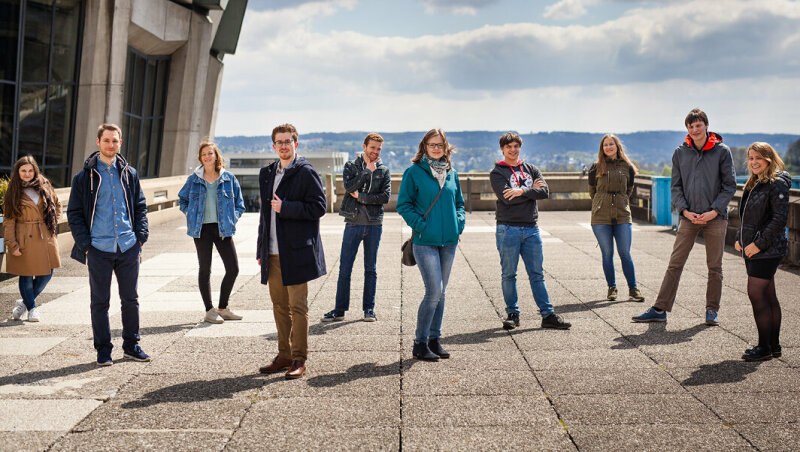
Bilder: © Cronauge (Bistum Essen) / RUB


Faculty of Catholic Theology

Faith. Thought. Presence.
Bochum is located in the heart of Europe’s biggest region of transformation, the Rhine-Ruhr area. The densely populated conurbation provides fascinating cultural, biographical, and religious variety.

Nowhere else in Germany will you find a similar degree of religious plurality in everyday life. Nowhere else is traditional Catholicism so closely linked with pervasive urban secularity. Nowhere else will you find cultural highlights and social flash points in such close proximity.

Such cross-overs are exactly the right place for theology.

We are one of 11 state-run full-sized theological faculties in Germany. And we are one of only six universities with both a dedicated Protestant theological faculty and a separate Catholic theological faculty – and this in a place known for outstanding academic research. Theological research is well placed at RUB because “religion” is a key topic in the research profile of the university as a whole.

Our research and teaching is dedicated to gaining a new understanding of the Second Vatican Council’s theological innovations. For us, religious identity in general and theological argument in particular is a form of critical contemporaneity.
We are educational institution, research centre, and academic service provider serving students, visiting academics, and colleagues.
Our conviction: We need places where “faith”, “thinking”, and “presence” interact, and each of the three serves to illuminate the others.

We invite you to contribute to the discussion!

Study

INTERNATIONAL ADMISSIONS
The Faculty of Catholic Theology at Bochum offers a number of different degree programmes. The two main types of programme are a double-specialisation joint bachelor’s/master’s programme and a single-specialisation degree programme in theology (leading to a Magister Theologiae and respective qualification in the ministry).

From the beginning of the winter semester 2002/03, the teaching degree programme for upper secondary schools has also been converted to the form of the new tiered BA/MA system. According to the "Y-model", students have to decide – upon completion of the BA degree, i.e. usually after six semesters – whether to pursue the specialist Master of Arts or the Master of Education, leading to a career in teaching.

Moreover, the faculty offers the possibility of completing a postgraduate licentiate exam (sacrae theologiae licentiae) as well as a doctoral degree (sacrae theologiae doctor) and the post-doctoral Habilitation qualification.
One of the requirements for admission to pre-diploma (Vordiplom) studies, aside from a university entrance qualification, is proof of adequate language proficiency in Latin, (ancient) Greek, and, in some cases, Hebrew.
Latin skills are also a prerequisite for the BA – and therefore also for the teaching degree programme. For students pursuing the Master of Education, Greek language skills – in addition to Latin – are strongly recommended, while the specialist MA will require Greek or Hebrew language skills depending on the chosen area of specialisation.

The licentiate requires proof of successful completion of language proficiency exams in Latin and Greek, and, if the licentiate thesis is written in an exegetical subject, proof of Hebrew language skills.
The necessary language skills may be acquired during the first years of undergraduate study, with proof required only when registering for the pre-diploma or BA examination.
Courses in English are currently still in development and are not generally available.

Research

Research at the Faculty of Catholic Theology comprises extensive individual research as well as interdisciplinary collaborative research. Three broad areas form a research profile which pools existing expertise without excluding outstanding individual research: (1) inter-religious relations: perception, interpretation, behaviours, legal entities; (2) identity – organisation – religion: the issue of “identity” as a positive religious side-effect of modernisation/transformation; (3) Christian ethics and practical charity.

A selection of individual research within systematic theology: investigation into an improved culture of dying in Germany (moral theology); theological reception of the philosophical theory of mutual recognition (fundamental theology); analysis of modernity discourses in Catholic theology in the 19th and 20th centuries (dogmatics).

A selection of individual research within biblical theology: constitution of identity in Persian Yehud (Old Testament); comparison of Jewish and Christian prayer (New Testament).

A selection of individual research within practical theology: the reception of church law in the media of the Federal Republic of Germany (church law); a comparative edition of Eucharist texts from the 20th century to the present (liturgical science); analysis of pastoral teams in US-American Catholicism (pastoral theology); investigation into inter-religious competence as a dimension of religious education (religious pedagogy).

A selection of individual research within historical theology: collaborative project “History of Charitable Institutions” (KG II); research into hagiography in late antiquity (KG I).
In addition to individual projects, researchers at the faculty are engaged in extensive collaborative research ventures: “Transformations within the trans-coding process of the Book of Numbers in the Hellenistic diaspora in Egypt” as part of the collaborative project “Trans-coding and Connection”; and the dynamics of religious transformation processes in modern times (KG II). The CERES Research Department is a centre of research for religious science. The Emmy Noether Research Group investigating the concept of infinity caught between theology, philosophy, mathematics, and the natural sciences (Chair for Interdisciplinary Questions of Philosophy and Theology )is also noteworthy.